




The best aftermarket parts do not always announce themselves as aftermarket.
Serge shipped his gloss-black sixth-generation Toyota 4Runner from South Carolina to Westcott Designs™ for a collection of upgrades. The strongest theme of the finished truck is visual integration. Several components look natural enough that the first reaction is to assume Toyota put them there.
They did not. That OEM-like appearance comes from matching the vehicle’s shapes, surfaces and proportions rather than simply attaching universal-looking accessories.
A Gloss-Black Finish That Belongs
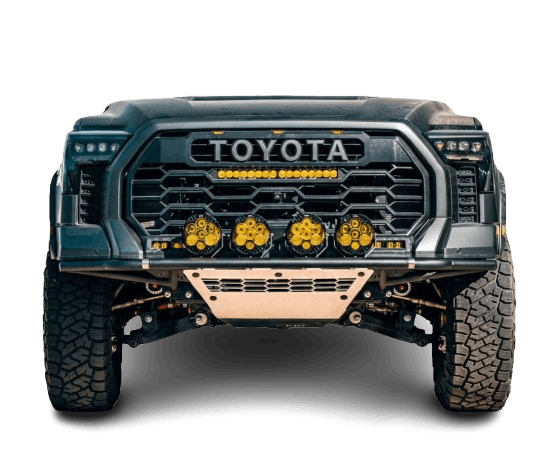
The bumper on Serge’s 4Runner was color matched in gloss black to create a uniform appearance with the rest of the vehicle.
For owners pursuing a factory-plus build rather than a deliberately industrial overland look, finish quality matters as much as hardware. Matching color, gloss level and surrounding body lines helps an aftermarket component become part of the truck rather than visually competing with it.
The Roof Rack Cutout Mirrors the 4Runner
One of the most interesting details is the shape cut into the Westcott roof rack. Compare the profile with the 4Runner’s fender openings and the relationship becomes obvious.
That repetition is intentional. It is a small design decision, but it explains why some accessories look at home on a vehicle while others look like universal parts adapted to fit.
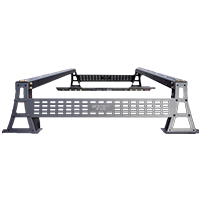
Westcott’s current 2025-2026 4Runner lineup includes Full-Length Modular and Lo-Pro roof racks. The modular version emphasizes configurable utility and optional floor inserts, while the Lo-Pro version emphasizes minimum installed height and a no-drill installation.
Molle Panels Cut to the Window Radius
The same design logic carries into Westcott’s exterior molle panels. The 6th-gen panels are laser cut and powder coated, and their shape follows the radius of the rear side window.
The panels can be ordered for the driver side, passenger side or as a pair. They attach to either the Westcott Modular or Lo-Profile roof rack and use industrial vacuum-pump suction mounts as part of the system.
Functionally, molle panels create exterior mounting space for gear. Visually, following the window radius prevents the panel from looking like a generic rectangle attached to a carefully sculpted vehicle.
When a Part Cannot Go in the Expected Location
The email teasing Serge’s build points out that one component could not be installed where it would normally go, so Westcott relocated it.
That is a useful lesson for any complex build. Aftermarket parts do not exist in isolation. Racks, lighting, recovery equipment, sensors, antennas, wiring and factory hardware can compete for the same space.
A good solution is not to force a part into a location simply because that is where it usually goes. The better approach is to preserve the component’s function, keep serviceability in mind and place it where the entire build works together.
Why Leaving Room in the Fenders Matters
Serge did not build this 4Runner just to park it. The email specifically calls attention to the remaining room in the fenders.
That restraint is important. A tire that barely clears while the vehicle is sitting level in a shop may contact bodywork when the suspension compresses, the steering reaches full lock or the truck is articulated off road.
A functional build needs dynamic clearance, not just parking-lot clearance. Leaving room can also preserve options for future tire or suspension changes.
Designing a 6th Gen 4Runner as a System
The most successful part of Serge’s truck is not any one accessory. It is the way the components relate to each other.
The bumper finish works with the paint. The rack borrows shapes from the factory body. The molle panels follow the window radius. A component that could not stay in its expected position was relocated rather than forced. The fenders still have usable room.
That is what an integrated build looks like: every decision considers the rest of the vehicle.
Frequently Asked Questions
Do Westcott 6th-gen 4Runner molle panels work by themselves?
No. Westcott states that they require either its Modular or Lo-Profile roof rack.
Can the molle panels be purchased individually?
Yes. Westcott lists driver-side, passenger-side and pair options.
Why does matching factory body lines matter?
It helps aftermarket parts look visually integrated and can produce a cleaner factory-plus appearance.
Why leave extra fender clearance?
Because real off-road clearance must account for steering, suspension compression and articulation, not just static ride height.